Showing posts with label Paleolithic art. Show all posts

Wednesday, 29 April 2009

Paleolithic art, part 6: Women in Paleolithic art

The representation of humans is comparatively rare in Paleolithic art, and only becomes widespread with the advent of civilisation. Where they are depicted, their sex is often ambiguous. However, in certain fields of art there is an abundance of female representations. Interpreting them poses the same problems as Paleolithic art in general.

This article does not claim to be a comprehensive survey of depictions of women, and it is orientated to Eurasia because of its focus upon figurines. My knowledge does not extend to female representation outside that region, but I may expand upon this article in the future.

Female figurines

By far the most common representations of women in the Old and New Stone Ages were small statuettes carved mostly from stone or ivory, of which the ‘Woman of Willendorf’ is one of the best known. These were created over a span of 20,000 years, the first of them appearing during the Aurignacian and Gravettian periods. In the Paleolithic, they appear across a huge area from France to Siberia; by the Neolithic this area shifts towards the Mediterranean and Near East. The abundance of female images suggests that women held a prominent role in prehistoric society — as we have discussed, this role is likely to have been different to men’s, but equal in importance.

Woman of WillendorfThe Woman of Willendorf, discovered at a Paleolithic site in Austria. It was carved from limestone ca. 24,000–22,000 years ago, and was once painted with red ochre. At 11cm long, it fits snugly into the palm of the hand. Photo: MatthiasKabel.

These figurines tend to emphasise female attributes — the breasts, buttocks, crotch, belly and thighs — while showing little interest in the face and extremities. The Woman of Willendorf is a good example: her breasts and genitals are carefully carved, but her arms, hands and feet are very understated and she has no face at all. Other well-known figurines include ‘the Lady in the Hood’ from Brassempouy, and ones made of baked clay from Dolní Věstonice. You can find more images of female figurines here. They are usually naked and sometimes plump, and some appear to be wearing jewellery or garments. Many have holes so that they may be worn as pendants.

It is unlikely that hunter-gatherer women could have achieved the plumpness of some of statuettes, and they are all stylised. So they cannot be understood simplistically as works of naturalism. The artists have chosen particular forms to convey social meanings; the problem is trying to reconstruct those meanings thousands of years later, often without knowing the stratigraphic context. There is, however, no shortage of theories.

Interpreting the figurines

One view could be that Paleolithic female figurines simply celebrate sex, which would not be extraordinary in itself. But that only begs two questions: why are they not more realistic, and why is sexual male imagery so rare (exceptions include for example the phallus found at the Hohle Fels cave in Germany). Early interpretations (by exclusively male archaeologists) saw the figurines, with their clearly marked sex organs, in erotic terms as a kind of pornography for Stone Age men. This interpretation of female images as serving male pleasure owes more to sexism than archaeology.

The most popular theory is that the figurines represent an interest in fertility. Men and/or women might have carved them as charms to encourage success in childbirth, perhaps to be worn by the woman. In this interpretation they become an affirmation of the idea of birth and rebirth, with the female as the ‘origin’ of life. The irony of this was not lost on Eleanor Leacock:

Women’s power of childbearing has been a focus for awe and even fear as long ago as the Upper Paleolithic, judging from the fertility figurines that date from that period. This point is easy to overlook, for the ability to bear children has led in our society not to respect but to women’s oppression.[1]

There has also been speculation about the figurines playing a role in fertility ‘cults’, but a cult implies rituals and practices for which, in the Paleolithic, little convincing archaeological evidence has been found. The site of Kostienki I in the Don Valley in Russia does provide an example: the great majority of the female statuettes found by archaeologists were buried in pits next to dwelling places together with tools and other items. The pits were covered with mammoth bones — almost like a dwelling constructed for the figurine — and were then filled in with silt and red ochre. This is evidence of ritual activity, but its purpose is unclear.

The ‘fertility’ theory has an obvious connection with the ‘magic’ theory of Paleolithic art, according to which images of pregnant women would be created to encourage pregnancy in real women. But the idea of sympathetic magic is not as convincing now as it seemed in the early twentieth century. Also, fertility is a greater concern for agricultural communities, which depend upon an adequate supply of human labour and the success of crops, than for Paleolithic hunter-gatherers whose population has practical limits. If the ‘fertility figurine’ idea may be correct in some cases, it cannot be taken as a blanket explanation. The figurines from Mal’ta in Siberia, for example, are slim and flat-bellied, which makes associations with fertility difficult to substantiate.

mal'ta figurineFigurine of a woman carved from mammoth ivory, ca. 23,000 years ago, found at Mal’ta in Siberia.

In 1981 the anthropologist Patricia Rice [2] found, after studying 188 figurines, that they depict women in a variety of types, conditions and ages: only a small proportion appear to be pregnant. There are also no images of children. Ethnography — though as ever we must be cautious about what it can tell us — has revealed no especial interest in fertility, or in the creation of female figurines devoted to it, among surviving hunter-gatherer peoples.

The ascribing of sexual meanings to images of nude women may owe more to the socialisation of (male) archaeologists than the images themselves. But we should equally not assume that an interest in female fertility or sexuality is unique to men. The figurines may be self-images by women, uninhibited by the mores of a less egalitarian society. LeRoy McDermott claimed that the stylisation of the figures means that they were self-images made by women, but there’s no evidence either way. By the same token, despite the existence of a male-defined culture of sexism, there is no single ‘male’ viewpoint, in prehistory any more than there is today.

Another interpretation proposes that prehistoric society was matriarchal, and in this context the figurines become images of a ‘mother goddess’. The existence of a prehistoric matriarchy was proposed as early as 1861 by Johann Bachofen, whose Mutterrecht und Urreligion (Mother Right and the Origins of Religion) is referred to by Engels in Origin. The theory that prehistory had been dominated by women and a mother-centred religion was taken up from the 1960s by sections of the feminist movement, keen to find positive alternatives to a history of oppression. Its less fortunate outcome was a quasi-mystical literature of minimal scientific value. Theories of a prehistoric matriarchy are not backed by anthropological evidence, nor is there evidence that Paleolithic images represented goddesses — deities probably don’t appear before the development of institutionalised religion during the late Neolithic. The Paleolithic images could be read as precursors of those religions, but again there can be no certainty.

The figurines were created over several millennia in an area spanning two continents, and the only thing they definitely have in common is their female subject matter. The temptation to look for a universal meaning is foiled at every turn. The figurines do not all have the same characteristics. Among the figurines from France alone, for example, the ‘Lady in the Hood’ from Brassempouy is unusual in having a carefully carved face and is also unusually naturalistic. So a single interpretation is unlikely to emerge. In reality, the figurines probably had different meanings for different communities: items for fertility ritual, charms, toys for children, teaching aids, or even simply ‘art for art’s sake’. Such interpretation is an ongoing challenge for archaeologists and anthropologists. However, in my view one conclusion can be made, which I explain at the end.

Women or Venuses?

I have illustrated above the ‘Woman of Willendorf’. Its more commonly used name is the ‘Venus’ of Willendorf, and the term ‘Venus’ has been applied to many Stone Age images of women. The term has an undistinguished history, coined by male archaeologists and predicated upon prejudice. It was first used in 1864 by the French archaeologist, the Marquis de Vibraye, when he found a Magdalenian figurine of a woman. This was perhaps a nod to classical art: based upon the Greek goddess Aphrodite, Venus was the Roman goddess of sex and beauty. But another archaeologist, Edouard Piette, later used the term for several sculptures found at Brassempouy in 1892, for reasons described by Randall White:

He identified two kinds of statuettes, obese and slim... He interpreted the slim figures from Brassempouy as Egyptian-like, and the other statuettes, representing much more ample women, were interpreted as South African (Bushman) types.[3]

Because the obese figurines did not accord with the prevailing European ideal of female beauty (one which is still with us in even more extreme form), Piette made a link with the steatopygous physique of some African women and used the term ‘Venus’ out of a sense of irony. The term continued to be used through the twentieth century as more images were found and given names. We may agree with White’s conclusion:

The application of the term ‘Venus’ resulted not from some extension to the Paleolithic of the reverence for classical art, nor does it involve a preoccupation with fertility. Rather, it stems directly from Western European racial/racist attitudes of the early twentieth century... In the light of this history, I would recommend abandoning ‘Venus’ terminology as inherently tainted and interpretively vacuous.

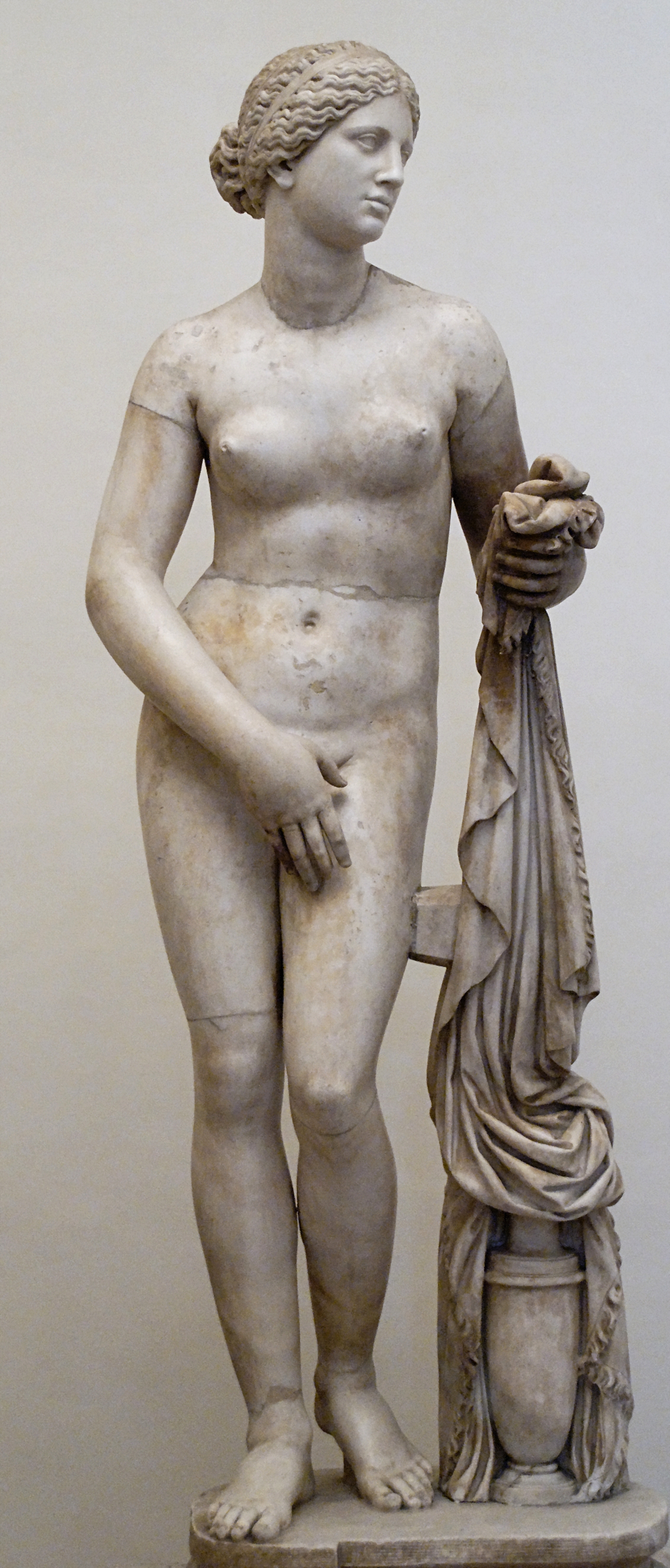
The ‘Venus’ label brings with it associations which do not help us to interpret the meaning of the figurine. The lesson is that our attitude to the art of the past is always coloured by our own cultural assumptions. When male archaeologists saw images of nude and well-endowed women, often with an unabashed delineation of the pudenda, they immediately evoked the goddess of sex and beauty. This tells us more about the society those archaeologists lived in than it does about Paleolithic art. Images of Aphrodite or Venus that have survived from ancient Greece and Rome often show the goddess naked, modestly trying to conceal her sexual organs with a gesture that does the exact opposite — draw attention to them (a good example is the Aphrodite of Cnidos by Praxiteles). Produced well after men had become dominant, these are principally works of sexual voyeurism.

The creators of Paleolithic art were humans like us, but they were living in a different kind of society. The Woman of Willendorf is a very frank object — the emphasis on sexual characteristics is uninhibited by the shame or repression that were to become expected female behaviours in male-dominated class society. As Christopher L.C.E. Witcombe put it, she is female, but she has not yet learned to be feminine.

Other female imagery of the Paleolithic

Not all Paleolithic imagery of women exists as statuettes. Examples have been found in painting, such as the drawing of the lower half of a woman on the ceiling of the cave at Chauvet (which strongly emphasises her crotch), and the three women engraved at Angles-sur-l’Anglin. An example of bas-relief is the image known as the ‘Woman with a Horn’. This is rare for being fixed art: it was engraved from limestone in a cave found at Laussel, near Lascaux in France.

Woman with a HornThe ‘Woman with a Horn’ from Laussel, ca. 25,000–20,000 years ago.

In her right hand the woman is holding a crescent-shaped object etched with thirteen incisions, towards which her head is turned. Commentators have seen the object as a bison horn; as a cornucopia, or ‘horn of plenty’; or as a moon, the incisions referring to the thirteen lunar months in the year. The woman’s left hand is placed upon her belly in what may be an indication of pregnancy, or a correspondence of the held object with her own cycle or the rhythms of nature. This is one of the few images where a theme of ‘fertility’ can claim some support from the artwork itself.

Another aspect of female imagery are engravings of what seem to be vulvae, carved into cave walls. Examples include those found near Les Eyzies in France. These are among the very earliest use of symbols, and the female pubic triangle survived as a symbol into the literate age as the basis for the Sumerian character for ‘woman’.

R. Dale Guthrie wrote that these images bore the “stamp of male youthful humour and ardour” and were “suggestive of unsophisticated, probably adolescent or juvenile, artists.”[4] But this may be little more than the old sexist reading in a new form. In a society that traced lineage through the mother, these images may have served as statements of stability, heritage or ultimate origin, or as celebrations of the reproductive power of women.

Interpretatively, we face the same difficulties as with the statuettes. These images would have had a great range of meanings specific to the cultures that produced them, but we do not know what they were: to see them as ‘sacred’ is a modern assumption. We can probably say that the predominance of images of female sexuality provide evidence that women were held in high regard during the Paleolithic. Yet even this is uncertain. If quantity alone were a measure of status, the magazine shelves of modern supermarkets would be evidence of outright gynocracy.

Conclusion

Our questions about the meaning of Paleolithic art in general, and of its depictions of women in particular, can currently be answered only by educated speculation. Archaeologists still have no idea whether Paleolithic art was made by men, women or both: if we knew the sex of the artists, it would cast new light upon those questions, although it would not by itself answer them. We don’t know why the figurines only appear in Eurasia, when humans had spread across most of the world. Our only option is a materialist analysis of the evidence, and self-awareness of our own cultural and gender assumptions.

We see nothing in Paleolithic art to contradict the belief that the sexes were of roughly equal status under primitive communism. The predominance of female images must however be explained. It probably reflects the central role of women in a matrilineal society that depended upon women for its own reproduction and for the majority of its calorie intake [5]. That ‘central role’ should not be mistaken for disproportionate political or economic power — matrilinearity does not mean matriarchy. Nor should the equality and peacefulness of prehistoric society be credited to women and their ‘nurturing’ nature, itself a gendered construct based upon subsequent prejudices; egalitarianism was in reality based upon the material limitations of production. Women are prominent in Paleolithic art for the same reason that animals are so prominent — they are central parts of the world view of those societies, and therefore of their artists.

In another article we will look at how the representation of women changed with their loss of status after the Neolithic Revolution.


[1] Leacock, Introduction (1972) to Engels’ The Origin of the Family, Private Property and the State.
[2] Patricia C. Rice, ‘Prehistoric Venuses: Symbols of motherhood or womanhood?’, Journal of Anthropological Research 37 (1981).
[3] Randall White, Prehistoric Art: The Symbolic Journey of Mankind (2003).
[4] R. Dale Guthrie, The Nature of Paleolithic Art (2006).
[5] See Piero P. Giorgi, ‘A new interpretation of female symbols and figures produced in prehistoric Europe — The hypothesis of the centrality of women’ (2007). Available in PDF format here.

Sunday, 18 January 2009

Paleolithic art, part 5: The magic of art

The perfecting of tools, and the advances in social and cultural organisation associated with them, won Homo sapiens an unprecedented power to alter the external world. One of the explanations of art offered by prehistorians is that our ancestors explained this power through the concept of sympathetic or hunting magic.

This theory dates back to the French archaeologist Salomon Reinach, but was particularly promoted by the pioneering Abbé Henri Breuil. Making analogies with surviving hunter-gatherer peoples, Breuil and others contended that Paleolithic art represented a kind of hunting magic. This theory was later taken up by semi-Marxists and Marxists such as Hauser, Fischer and Sánchez Vázquez. There are various problems with it, but let us begin with the theory.

The magic theory

The theory starts with the proposal, convincing in itself, that it is unlikely that Paleolithic cave paintings were created to decorate the places where people lived. Paleolithic people did not live in caves, or only occupied the entrances of them, whereas some of the paintings are hidden in dark corners and can only be seen by lying down. They are also painted at conflicting angles and even on top of each other, which would ruin any decorative effect. Hauser articulated it well:

A whole series of indications argues against such an interpretation, above all the fact that the paintings are often completely hidden in inaccessible, absolutely unilluminated corners of the caves where they would have been quite impossible as ‘decorations’. Their palimpsest-like superposition, destroying any decorative effect from the very outset, also argues against such explanations. After all, the painters were not forced to paint their pictures one over the other. They had space enough. This very superposition of one picture over another points to the fact that the pictures were not created with any intention of providing the eye with aesthetic enjoyment but were in fulfilment of a purpose in which the most important element was that the pictures should be accommodated in certain caves and in certain specific parts of the caves...[1]

Speculation naturally followed that this art had a ceremonial or spiritual significance. Hauser sees the inaccessibility of the paintings as proof of a ‘magical’ purpose.

The magic theory contends that during the Paleolithic period there was none of the complex separation of art and reality that occurs later. The act of acquiring power by imitation was extended by Paleolithic hunters and artists beyond tool-making and language, until there was no separation between the image of the animal and the animal itself. Hunters hoped that by making an image of an animal, they would acquire power over it. In Hauser’s words:

The Paleolithic hunter and painter thought he was in possession of the thing itself in the picture, thought he had acquired power over the object in the portrayal of the object. He believed the real animal actually suffered the killing of the animal portrayed in the picture. The pictorial representation was to his mind nothing but the anticipation of the desired effect; the real event had inevitably to follow the magical sample-action, or rather to be already contained within it, as both were separated from each other merely by the supposedly unreal medium of space and time... It was not the thought that killed, not the faith that achieved the miracle, but the actual deed, the pictorial representation, the shooting at the picture, that effected the magic.[2]

Many of the cave images show animals surrounded by arrows and spears, or by human hunters, and they were even stabbed or shot at.

Horse from LascauxHorse from Lascaux. It appears to be under attack from spears or arrows.

Art was expected to assist in the hunt, and owes its finely-observed naturalism to the need to recreate the animals as closely as possible. The animals are drawn from the side, where their form was most apparent and complete; where they had distinctive features like antlers, the head would be turned so that these too could be seen at their most representative angle. Dance would have originated in the same way, as a group imitation of the animals that we would shortly hunt.

This might explain why human beings are depicted far less often than animals in Magdalenian paintings, and then in a less naturalistic form. Given the supposed power of an image to correspond with a real being, they may have worried that creating images of people could expose them to harm. The power of this correspondence between image and living person has never quite left us: as famously explored by Oscar Wilde in The Picture of Dorian Gray.

Paleolithic magic would not have resembled religion as we understand it today, with its elaborate rituals, scriptures, esoteric myths and hierarchies. There were neither the resources nor the social organisation for that. The magic was as direct a part of the hunt as the sharpening of a spear. This art was part of our determination to exert control over our environment: art, spirituality and science were one and the same.

Problems of the magic theory

One reason we need to examine the magic theory is that it was taken up by several Marxist writers in the first half of the twentieth century. Marxists worth their salt look to contemporary scientific thought, and sympathetic magic was for a time the predominant theory among archaeologists in interpreting Paleolithic art. “Any other explanation of Paleolithic art,” wrote Hauser, “…is untenable.”[3] Fischer wrote that “The magic of tool-making led inevitably to the attempt to extend magic to infinity… Art was a magic tool.”[4] In 1965, Sánchez Vázquez confidently asserted: “Today no one has any doubt about the close relationship between art and magic in the Upper Paleolithic period.”[5] Max Raphael, in his influential book Prehistoric Cave Paintings, proposed that Paleolithic art was totemic, adding: “that totemism and magic co-existed in the world-view of the paleolithics in a specific manner is indisputable.”[6] All of these writers either drew or are likely to have drawn theoretical backing from the writings of the Marxist archaeologist Gordon Childe.

The attraction of the theory for Marxists at that time is obvious: there is no doubt that ‘making alike’ played an essential part in our aesthetic development, and the magic theory is a plausible extension of it. Above all it emphasises humans acting to take control of their environment. But our archaeological knowledge and technique is much better today, and it is clear that there are limitations to what the theory can explain.

The first problem is that it relies upon ethnological comparisons with modern hunter-gatherer societies. Such societies are by their nature exceptional rather than typical. Most societies progress socially and technologically, so any that remain in the most ancient mode of production are anachronistic by at least 5,000 years. Even when a society is in arrested economic development, meanings will shift and change across thousands of years: modern Aborigines for example are unable to explain to researchers the art of their Paleolithic ancestors. We simply cannot know what Paleolithic people believed, because they left no written explanations of the meanings they attributed to their images.

Another problem is that the inaccessibility of parietal art, often claimed as evidence of ritual or magical purpose, is in fact exaggerated — many images are not in especially obscure places, especially at African sites. R Dale Guthrie suggests that Paleolithic people quite possibly did paint the great majority of their paintings in accessible public places [7] — it is just that the works in protected, inaccessible locations are the only ones that have survived.

Even if sympathetic magic was important to one Paleolithic culture, it may not have been for others. It does not explain the presence of non-prey animals (the Chauvet cave features a hyena and a leopard), or of abstract symbols and handprints. Not all the images of prey animals are highly lifelike. The painters of Lascaux hunted reindeer and left their remains in the caves, but the caves have no images of reindeer at all. It does not explain what to make of the statuettes of women — an association with encouraging fertility can not be assumed, as this was an impoverished society that probably wished to limit population growth as much as to increase it. The wary avoidance of the human image seems contradicted by the 155 engraved human portraits found in on the floor of a cave at La Marche in France [8], and although rare in Magdalenian paintings, they are not uncommon outside Europe. And alongside the fine cave paintings, there is a mass of other images, engravings and ornaments that is the stuff of everyday life and refuses to fit into the scheme of the theory of hunting magic.

So-called sorceror from Le GabillouA figure at Le Gabillou in France, which appears to be half-animal and half-human and has been described as a ‘sorcerer’. A similar figure was found at Les Trois Frères in the French Pyrenees. Such images may well be magical, but hunting magic does not seem adequate to explain them.

Hunting is only one element in Paleolithic art. There is imagery that suggests an understandable interest in sex, and perhaps rituals of fertility. The half-human, half-animal beings may be totemistic, as Raphael suggested. Ethnographic parallels have led to the proposal — for example from French prehistorian Jean Clottes and South African archaeologist David Lewis-Williams — that cave art is not magical but shamanistic: i.e., that they were part of a ritual that induced a trance-like state to make contact with the spirit world. As shamans danced themselves into an altered physiological state, they experienced brightness, patterns of light and shapes, and saw animals within those shapes. Paleolithic parietal art was the attempt to reproduce hallucinatory imagery.

Before we dismiss superstition and the mass of false beliefs that accompany it, we must remember that Homo sapiens was still a new kind of being, with an extraordinary consciousness which we were just beginning to try and understand. Our attempt to find meanings were derived from our lived experience at that time. Although magic is a fantasy, the idea of correspondence is still in use today, and not just in religious practice — we see it every time we burn a figure in effigy. And the correspondence of a drawn symbol with a word, which in turn represents a thing, is a requirement for the invention of writing.

The problems with the theory of sympathetic magic do not necessarily mean that the Marxists who adopted it were entirely wrong and that magic has no relevance whatsoever to Paleolithic art. It is the promotion of it in ways contradicted by evidence that is untenable. The case in support of the magic theory is well argued — but it can only be part of the answer. We must remember Randall White’s observation, cited in an earlier article, that no interpretation of Paleolithic art can be applied to every work.

In one sense there is no need to struggle for an explanation for what this art was ‘for’. Nobody would suggest that modern art had only one motivating cause, and there is no need to try and find one for Paleolithic art either. A cave painting created to assist the hunt may happily exist alongside a face whittled from bone for the pure fun of it. Art is humans’ attempt to affirm their intellectual, emotional and physical powers in concrete, sensuous form. As such, it is as diverse as humanity itself.


[1] Arnold Hauser, vol. 1 of The Social History of Art (1951). Hauser’s over-simplified view of prehistoric art has become dated.
[2] Ibid.
[3] Ibid.
[4] Ernst Fischer, The Necessity of Art (1959).
[5] Adolfo Sánchez Vázquez, Art and Society (1965).
[6] Max Raphael, Prehistoric Cave Paintings (1945). Max Raphael was a German art theorist who moved to France and then the US to escape Nazism. Adopting Marxism in the 1930s, he offered us some of the most intelligent and sensitive Marxist writing on art. This essay was an important part of a new generation of work in the 1940s and 1950s that sought to go beyond early interpretations of Paleolithic art. He proposed that the paintings were much more structured than previously thought.
[7] See R. Dale Guthrie, The Nature of Paleolithic Art (2006).
[8] I should add that there are doubts about the authenticity of these images, which would be remarkable if genuine.

Wednesday, 14 January 2009

Paleolithic art, part 4: Interpreting Paleolithic art

Despite its rich achievements, the art of the Paleolithic — the longest-lived artistic era in human history — was not systematically studied until the late nineteenth century. The famous European cave paintings only came to modern scholarly attention in the 1860s, and the art of other parts of the world had to wait even longer before it received serious study. We have no opinion from Marx or Engels on them, and the only Marxist art theorist to have given them detailed consideration is Max Raphael.

It would be an exaggeration to say that the art was suddenly ‘discovered’: as the British archaeologist Paul Bahn has pointed out [1], local people had often been aware of nearby art sites, and writing about prehistoric art dates back to at least the Chinese writer Han Fei in 280–233 BCE. However there was good reason for a surge of scholarly interest in nineteenth century Europe. In his book The Descent of Man, Darwin had challenged Christian fairy tales by proposing that humans, rather than springing ready-made into the Garden of Eden in approximately 4004 BCE [2], had evolved from primates over many thousands of years. As recently as 150 years ago, it was still assumed by most scientists in the West that human beings and all other species were both immutable and divinely created. In this context there could be no understanding of the sheer antiquity of Paleolithic art — it took twenty years before archaeologists accepted that the art at Altamira and other sites was authentic. Even when its real nature was accepted, the earliest scholarship put forward a theory of ‘art for art’s sake’, finding it hard to ascribe complex behaviours to people whom they considered simple and primitive.

Even with the powerful techniques of contemporary science, it is very hard to speak with certainty about what the paintings and artefacts of such a remote era ‘meant’ to the people who created it. As R. Dale Guthrie put it, “Who were humans before all the stuff of crops, villages, churches, dogs, property, houses and wars?”[3] Many of the usual data of interpretation, such as written records, do not exist, and ethnological parallels with modern hunter-gatherers are simply not reliable. We don’t know if art was created by men or women, or if creation of different types of art was divided between them, or if artists had any special, perhaps shamanic, status (the very idea of an ‘artist’ distinct from non-artists may well have been alien to them). It would be careless to ascribe the same meaning to an Aurignacian bison at Chauvet and to a pre-Estuarine kangaroo from Kakadu, Australia, and even in the same region it is almost certain that art’s meaning will have changed over the immense 30,000-year span of the Upper Paleolithic. We must always therefore be on our guard against over-ambitious hypotheses. Randall White makes a pertinent observation, which references cave art but stands just as well for all art of the period:

There has always been a tendency on the part of scholars and the general public alike to attempt to account for all of Paleolithic cave art with a single explanatory model: art for art’s sake, hunting magic, fertility magic, mythograms, shamanism. As a result, carefully selected images are often presented to bolster one or another of these interpretations, leaving the vast majority of images unexplained. For example, perhaps 10% of the known images conform to the expectations of a shamanistic interpretation. What, then, do we do with the remaining 90%?... No single characterisation of the cave environment is adequate and no single interpretation of cave painting will suffice. [4]

We must cast aside Western assumptions about art: that it is an act of self-expression by an individual artist that results in an ‘art object’, an activity separate both from practical concerns and from mere ‘crafts’. The very idea of ‘art’ as a distinct category of activity is alien to how most humans in most times and regions have viewed creative labour. Even seeing and feeling are conditioned by culture, so the Paleolithic conception of art will have been very different to (speaking as a Westerner) our own. Its meaning will have changed over the millennia and varied across regions.

All we can do is carefully sift through the archaeological layers to find concrete objects, dates, materials, etc, and deduce what we can from the evidence. Our conclusions are becoming richer as excavation yields new finds and archaeology combines with other disciplines to develop as a science. Each work of art arises in a particular social context, and the more we can learn about the material facts of Paleolithic life, we more confidently we can attempt cultural interpretations. Thus the key to understanding Paleolithic art lies as much in the everyday debris of the cave floor as it does in the art objects themselves.

The first observation that must be made is that these are works of outstanding quality. There is no doubt that these are true works of art, which show great symbolic and technical skill. It is prehistoric, but it is not primitive. “We see,” wrote Max Raphael, “that despite external differences, these works of art are fundamentally the same as those of today.” After visiting Lascaux in 1940, Picasso reportedly declared: “We have learned nothing in twelve thousand years.” All of the major art forms we know today — painting, sculpture, engraving, bas-relief, music, charcoal drawing — existed from the beginning.

Art and the Paleolithic social context

We mustn’t overlook a second, very obvious, observation: Paleolithic art represents the pre-occupations of human beings at the time, conditioned by the materials and environment available to them.

In discussing prehistoric art we must shed the ‘caveman’ stereotype of a heavy-browed simpleton with a club and remember that the people of the Upper Paleolithic period had equal faculties to ourselves. As Colin Renfrew observed, “a child born today, in the twenty-first century of the Common Era, would be very little different in its DNA — i.e. in the genotype, and hence in innate capacities — from one born 60,000 years ago.”[5] However they were people who had to subsist from one day to the next in impoverished conditions. Arnold Hauser correctly commented:

We know that it was the art of primitive hunters living on an unproductive, parasitic economic level, who had to gather or capture their food rather than produce it themselves; men who to all appearances still lived at the stage of primitive individualism, in unstable, almost entirely unorganised social patterns, in small isolated hordes, and who believed in no gods, in no world and life beyond death.[6]

He goes on to conclude “in this age of purely practical life everything obviously still turned around the bare earning of a livelihood” and that art must have served to help procure food. By this he refers to the theory of hunting magic, which we will discuss later.

Today archaeologists are less certain that Paleolithic life was as harsh, and the struggle for survival as all-consuming, as used to be assumed (in Leviathan, Thomas Hobbes famously described it as “solitary, poor, nasty, brutish and short”). Paleolithic skeletons are in surprisingly good condition, because of the high quality of their diet. As early as 1966 the American anthropologist Marshall Sahlins controversially suggested that hunter-gatherer society was even the ‘original affluent society’, because their food-gathering skills provided for all and that leisure time was greater than today.

Marxists have no time for utopian hankerings after a ‘golden age’. It is a myth that humans once all lived in a simple and sustainable balance with nature. Humans, because of their unique cognitive powers, have never been in balance with nature: we might cite the probable extinction of large land mammals by over-hunting, or the disastrous deforestation of Easter Island, as evidence that ancient societies were just as able, on their own scale, to degrade their environment as we are.

But it is likely that some members of the tribe would have spent an amount of time producing art that was disproportionate in a society supposedly desperate for their next meal. Skill in carving figurines requires a lot of time and practice. The cave paintings and engravings would have been difficult and expensive to make: their lamps needed copious animal fat and the paintings often cover a large area and are at some height above ground level. The people found in the Paleolithic graves at Sungir had been buried with thousands of ivory beads — hundreds of hours of labour had been expended on objects that were simply buried in the ground.

Productivity must reach a certain level before works of art can be created, as people who are on the brink of starvation cannot afford to expend labour on objects with no practical use-value. Marx wrote: “A man who is burdened with material cares, who is suffering great hardships, cannot appreciate even the most beautiful spectacle.”[7] Paleolithic society was prepared to invest resources in its art, and that required a basic economic development — the result of better social organisation and new technologies such as the harpoon — capable of providing those resources. It was learning to acquire a social surplus product, that is, to accumulate food reserves over and above what was strictly needed in order to stay alive. Thus people who had a particular aptitude for art could take the very early steps towards specialisation — towards being artists as such.

The meagre Paleolithic level of production allowed for only a rudimentary division of labour. The principal division of labour was not between specialists but between men and women. This was a pre-class society, in which every member lived in the same general poverty, and had to do their fair share of food-gathering. There was no material basis for a state or for the hoarding of property by a minority, which suggests their society was basically egalitarian. This is the period known to Marxists as ‘primitive communism’. Engels described it this way (the gens is a kinship group based upon common descent):

No soldiers, no gendarmes or police, no nobles, kings, regents, prefects, or judges, no prisons, no lawsuits — and everything takes its orderly course. All quarrels and disputes are settled by the whole of the community affected... Although there were many more matters to be settled in common than today — the household is maintained by a number of families in common, and is communistic, the land belongs to the tribe, only the small gardens are allotted provisionally to the households — yet there is no need for even a trace of our complicated administrative apparatus with all its ramifications. The decisions are taken by those concerned, and in most cases everything has been already settled by the custom of centuries. There cannot be any poor or needy — the communal household and the gens know their responsibilities towards the old, the sick, and those disabled in war. All are equal and free — the women included. There is no place yet for slaves, nor, as a rule, for the subjugation of other tribes.[8]

This should not be taken to mean that prehistoric society was a kind of utopia. The absence of alienation and class exploitation may be something to envy, but the standard of living was severely limited by very low productivity.

In a time when co-operation and community could mean the difference between life and death, it is tempting to conclude that works of art were an integral part of society: in a sense they were as utilitarian as they were spiritual. Rituals, ceremonies, dances, artifacts and so on would have emphasised to a small Paleolithic band the sense of belonging to a social group. A belief in the magical powers of certain artifacts would have provided certainty in a life where much was beyond our control. The elaborate working and perfecting of cultural objects would have stressed the importance of the set of shared beliefs and customs concretised in their particular forms.

The Paleolithic artist

Nowadays we often think of artists as solitary beings, pursuing a private vision in spite of the mockery around them, and the role of art has indeed changed for a variety of reasons. But for the vast majority of art’s history there could be no question of the ‘misunderstood’ artist struggling against his contemporaries. Because I am human, wrote Marx, “my own existence is social activity, and therefore that which I make of myself, I make of myself for society and with the consciousness of myself as a social being.”[9]

Paleolithic people did not produce ‘art objects’ to be placed in galleries or museums, or to sell on the market (leading many prehistorians to reject the word ‘art’ altogether for this period and to prefer the term ‘symbolic representation’). Art in hunter-gatherer society, besides being the product of labour, was and is a social activity in which all participate. For these people, dances and storytelling were not solitary acts of contemplation or self-expression but rituals that bound together their communities. As Ernst Fischer put it: “Art in all its forms — language, dance, rhythmic chants, magic ceremonies — was the social activity par excellence, common to all and raising all men above nature and the animal world”:

An artist can only experience something which his time and social conditions have to offer. Hence an artist’s subjectivity does not consist in his experience being fundamentally different from that of others of his time or class, but in its being stronger, more conscious, and more concentrated... Even the most subjective artist works on behalf of society. By the sheer fact of describing feelings, relationships, and conditions that have not been described before, he channels them from his apparently isolated ‘I’ into a ‘we’... [10]

The community was paramount, for in these times being cast out of it literally meant death; binding communities through culture gave adaptive advantage.

Art has never lost this social function. No artist lives in a social vacuum; we are all subject to the influences and ideas that are on offer in our particular time and place. An artist, however ‘original’, does not produce ideas unconnected to those of his or her society, and art only succeeds if it can speak to us all. This does not mean that the artist may not be highly individualistic; it is rather that the best artists concentrate social experience and its most profound contradictions and processes. We shall explore this subject in more detail when we consider ‘genius’ and the relationship of the artist to history.

Conclusion

The traditions of Paleolithic art came to an end because of radical changes in human society that were spurred by climatic changes and economic development. From painting caves we began painting houses — from naturalistic carvings of animals we began carving gods and kings. Steven Mithen observed:

The ending of the cave art tradition should not be attributed to cultural disintegration, social collapse, or the arrival of a dark age when minds were closed to the arts. The cessation of cave painting is a remarkable testament to the ability of people to rewrite the rules of their society when the need arises.[11]

It is an important truth about art that despite its immense variety across cultures, its fundamental nature never varies. Whatever a particular culture may believe about the provenance of art, e.g. supernatural intervention, art is always in fact the work of human skill and imagination. It is the affirmation of our human powers in concrete, sensuous form, and our species character has altered little in the evolutionary blink of an eye that is 40,000 years. For this reason we can still admire this art today, even without understanding the complex meanings it would have possessed for its makers — a human vision survives across the millennia.


[1] Paul Bahn, The Cambridge Illustrated History of Prehistoric Art (1997). Incidentally I shall repeat that my citing these writers does not mean they are Marxists, only that their scientific contribution in my view complements a materialist conception of art.
[2] As calculated by Bishop Ussher in the 17th century.
[3] R. Dale Guthrie, The Nature of Paleolithic Art (2006). Guthrie’s controversial book contends that rather than seeking symbolic and ritual meanings in Paleolithic art, we should see it as much more everyday, even casual. Sceptical of the ‘magico-religious paradigm’, he claims that most cave art was created by adolescents and demands parallels with graffiti.
[4] Randall White, Prehistoric Art: The Symbolic Journey of Humankind (2003).
[5] Colin Renfrew, Prehistory: The Making of the Human Mind (2007).
[6] Arnold Hauser, vol. 1 of The Social History of Art (1951).
[7] Karl Marx, The 1844 Manuscripts (1844).
[8] Friedrich Engels, Chapter 3 of The Origin of the Family, Private Property, and the State (1884).
[9] Karl Marx, Third Manuscript, The 1844 Manuscripts (1844).
[10] Ernst Fischer, The Necessity of Art (1959).
[11] Steven Mithen, After the Ice: A Global Human History 20,000–5000 BC (2004).

Monday, 22 December 2008

Paleolithic art, part 3: The flowering of culture

The artistic achievements of Homo sapiens are unambiguous and magnificent. This was the first true art to be created by a human species, and it seems to have emerged fully-formed. Paleolithic artists had to practice their skills like anyone else, but the works they produced are the equals of those of subsequent ages. Art, as we shall explain elsewhere, does not ‘progress’ in the way science does; it simply takes different forms depending upon its historical context. What it has in common is that it is the affirmation of human creative and intellectual powers, and in Paleolithic people those powers were the same as our own. This was the first great period of art, and it was also the longest.

The richest source of Paleolithic art has been Western Europe, not because Europe was ‘superior’ but because it has been most extensively explored. This emphasis is due to resources and racism, not to differing ability amongst various peoples, as prehistoric art of comparable quality has also been discovered in Eastern Europe, Africa, Australia and the Americas. Outside Western Europe many important sites exist, of which the following are the merest handful — in Eastern Europe, Dolní Věstonice in the Czech Republic, Kostienki and Borshevo in the Don Valley in Russia, and Sungir; in Africa, Apollo 11 in Namibia and the Drakensberg mountains in South Africa; in Australasia, the Niah Cave in Borneo, and Arnhem Land and Kimberley in Australia; in the Americas, Pedra Furada in Brazil.[1]

The Upper Paleolithic has been divided by art historians into periods, each representing a technical advance upon its predecessor. Of course, these exist only as labels used to try and make sense of stages of development. They vary from region to region: in Western Europe, the best documented region, they are the Aurignacian (beginning 40,000 years ago), the Gravettian (28,000 years ago), the Solutrian (21,000 years ago) and the Magdalenian (18,000 years ago) — the Magdalenian saw a particularly rich blossoming of symbolic artifacts. In other parts of the world, these labels must be either applied differently or discarded altogether. On our current evidence, there was no generalised flowering at the same time across all human communities.

Most Paleolithic art is now lost. Story-telling, music or dance take no concrete form that may survive into subsequent epochs, and many objects would have been made of perishable materials such as bark, feathers, mud, wood or hide. Many images would have been painted upon open-air surfaces and have simply worn away. The anthropologist Olga Soffer found imprints left on ceramics 25,000 years ago by textiles, but these textiles have long ago disappeared.

There are two sets of exceptions, surviving examples of which number many thousands. One of them is known as ‘mobiliary’ art, which consists of portable objects such as sculptures.

Mobiliary art of the Paleolithic

These sculptures portray humans, animals, and even mixtures of the two. In the Aurignacian there appear sculpted female figures, like the figurines found at Willendorf and Lespugue — there are few such sculptures of males. Their exaggerated sexual characteristics have led some archaeologists to suggest they were symbols of fertility (more on that topic in a dedicated article).

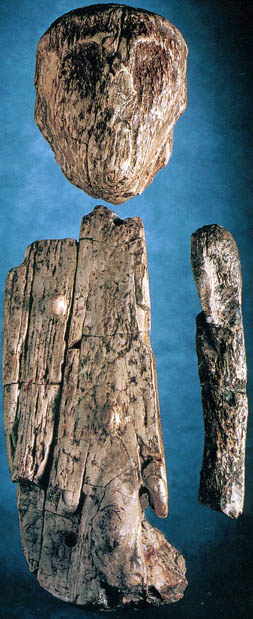
The Gravettian site of Dolní Věstonice in the Czech Republic has been particularly rich in these finds, and the remains of little clay figurines, baked in kilns, provides evidence that around 26,000 years ago ceramics had been invented; the site gave us a female statuette which is the oldest known ceramic in the world. It also revealed a male statuette or marionette made of ivory, of which all that remains are the head, torso and left arm.

Dame à la Capuche from BrassempouyThe so-called Dame à la Capuche (‘lady with the hood’), discovered at Brassempouy in France in 1892. About 25,000 years old, it is the oldest known depiction of a human head. Very probably female, it is carved from ivory and is just 3.6cm high.

Interestingly, such figurines are not found outside of Europe and Russia, even though our species was distributed over most of the world by the end of the Pleistocene.

In the Hohlenstein-Stadel cave in Germany, a statue was found made of carved mammoth tusk, representing a half-human, half-lion figure; its purpose may have been shamanistic. Another beautiful example is a tiny horse carved from mammoth ivory found in the Vogelherd caves in Germany, which had been perforated to be worn as a pendant. A cave site at Mas d’Azil in the French Pyrenees has yielded some of the finest carvings of the Stone Age: among them a horse’s head and an ibex beautifully captured in a moment of tension.

Other mobiliary art includes small objects of bone, stone or ivory engraved with markings of uncertain meaning: they have been described as tallies or astronomical records. We also have personal adornments such as beads and perforated shells and animal teeth. There were even musical instruments, such as the 36,000-year old flute found at the cave at Geissenklösterle in Germany — and if they made music, Paleolithic people must have sung and danced too. You can read my article on Paleolithic music here.

Parietal art

The other set of surviving Paleolithic art works is known as ‘parietal’ art — paintings and engravings in caves and on rocks. The most famous are the magnificent paintings of European sites like Lascaux, Altamira and Chauvet, but there are thousands of rock art sites in Africa and Australia too, and new sites are being discovered every year. In Europe parietal art appeared 32,000 years ago at French sites like the cave at Chauvet, home to the oldest known paintings in the world, but the great majority of European parietal art was created by the Magdalenians, with those of Lascaux dating to around 15,000 years ago.

Paintings from LascauxPaintings from Lascaux. Photo: Jack Versloot.

The artists painted with the materials available to their technology: ochre (a pigment made of tinted clay), manganese oxide (a source of black), hematite (an iron oxide that leaves reddish marks) and charcoal. Their techniques showed sophistication from the beginning, such as ‘pointillist’ dot paintings, using the natural contours of the cave to give form to the representations, and scraping the rock surface to indicate negative space by revealing lighter rock beneath.

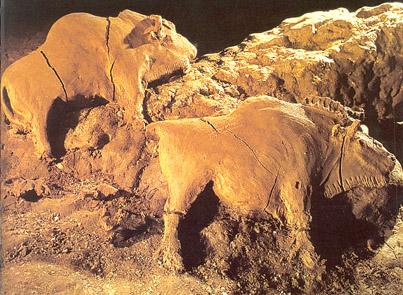
There are also images that have been engraved or pecked into the rock, and even bas-relief sculptures. Two sculptures of bison modelled in clay, found in the Tuc d’Audoubert cave in France in 1912, show a skill equal to that of subsequent eras.

There is an extremely rich tradition of rock art in Africa, but dating the sites is more problematic. Cave painting there seems in general to date to about 12,000 years ago, after the Pleistocene, which poses something of a puzzle for archaeologists — given that Homo sapiens originated in Africa, why does parietal art appear there so much later than in Europe, which our species only colonised some 40,000 years ago? Why was the flowering of cave art in what is now France and Spain such a localised phenomenon? As yet, we cannot say.

The subject matter of cave art is extremely limited, and is striking for what it does not show or tell. There is little evidence of composition or of narrative. There are no structures, no objects, no suns or landscapes or horizons. The art tells us little directly about everyday life, social structure, family life, the role or status of the artist, etc. The images predominantly depict animals such as bison, horses, mammoths and bears. People are relatively rare, although they become more common later.

In addition to representational paintings there is a wide variety of symbolic markings. These include handprints, both as silhouettes and as direct impresses of a hand marked with paint, or finger-markings like those of Koonalda Cave in Australia. Other, geometrical, symbols have been described in various ways, for example as vulvas. Such descriptions may owe more to modern observers’ striving to make sense of them than to the evidence. The markings’ indisputable point of interest is that they are repeated in the same form over and over again, that is they are not necessarily random acts of mark-making or doodling — although these do exist — but seem to have symbolic consistency. Just as the symbols of modern hunter-gatherers, and of modern urban society, have a broad and rich variety of meanings, we can expect that Paleolithic people invested their symbols with meanings of similar complexity.

The earliest architecture

Although we think of the Paleolithic hunter-gatherers as living a nomadic lifestyle, there is evidence that they built shelters. The very first glimmerings of this would have been campsites or hearths bearing evidence of controlled fire use. Our first examples of this date to the Middle Paleolithic.[2]

The earliest proposed evidence for actual buildings dates as long ago as 380,000 years ago: at the Terra Amata site near Nice, alongside Acheulian flint tools, archaeologists found arrangements of stones which have been interpreted as being the foundations for temporary shelters. This evidence is, however, very inconclusive.

During the Upper Paleolithic, the existence of buildings becomes indisputable. The most striking are huts found in the Czech Republic, Poland and the Ukraine, where the open plain offered less protection via natural features like caves. These shelters were built from the bones of woolly mammoths, and are sometimes a handful are clustered together, like a prototypical village. A structure at Mezhirich in the Ukraine required the bones of 95 mammoths and was made about 15,000 years ago. (You can find images here.)

Further west, such structures were less necessary, but there is still evidence that Paleolithic people altered the interiors of caves with hearths and partitions.

Conclusion

Prehistory spans an immense period of time, most of it falling in the Paleolithic. If we consider humans to have begun creating art 40,000 years ago, and that the period ends 10,000 years ago with the Neolithic, this gives us a very approximate span of 30,000 years. By the end of this period, art can be found on all the continents save human-free Antarctica. So all we can do here is skim across the surface of a vast topic.

In addition, we must remember that the surviving examples are just the tip of the iceberg. Paleolithic societies probably produced an immense amount of painting, textiles, music, dancing body-painting, figurines and so on, the vast majority of which would have been created using perishable materials and are irretrievably lost. Absence of proof for such objects is of course not proof of absence. If our knowledge of surviving hunter-gatherer societies were to be limited to objects that fossilised, we would have only the barest impression of their culture, and some might even conclude that they were less intelligent or had no art.

Not only is the Paleolithic the longest artistic ‘period’, it is also the first. We can spend thousands of words speculating on the origins of symbolic communication in our species, but these images and objects represent the first unequivocal evidence of information being stored symbolically outside of the human mind, being externalised through human labour. This is why exploring it is important — it will help explain human evolution and the origin and nature of art. This process of exploration can never be straightforward, as Colin Renfrew observed: “The image of the past that we see is one that we ourselves have constructed. It is one that is continually changing.”[3] We shall consider the interpretation of Paleolithic art in the next article.

Read also my article on Women in Paleolithic Art.


[1] In Asia, the record for Paleolithic art is very scanty, despite the presence of Homo erectus in China and Java half a million years ago. The only reliably dated rock art in China to my knowledge is the rock face at Huashan, which is just over 2000 years old and thus not of Paleolithic origin.
[2] There is a difference between being able to control fire and deliberately building fireplaces. Humans may have begun to control fire as early as Homo erectus, but exactly how and when remains moot. The earliest known evidence of fire use comes from Swartkrans in South Africa and dates to 1.5 million years ago, but is disputed by many scientists. A probable date for the widespread controlled use of fire is about 125,000 years ago.
[3] Colin Renfrew, Prehistory: The Making of the Human Mind (2007).

Further reading
It is not my intention in this blog to provide a comprehensive survey of Paleolithic art, which would be impossible anyway. To readers who want to know more, here’s a handful of recommendations:
• The Prehistory section of the Heilbrunn Timeline of Art History (starts 20,000 BCE).
Parietal and mobiliary art at the Palanth forum (International Journal of Palaeoanthropology).
A virtual tour of Lascaux (click ‘Discover’).
• Paul Bahn, The Cambridge Illustrated History of Prehistoric Art (Cambridge University Press, 1997)
• Randall White, Prehistoric Art: The Symbolic Journey of Humankind (Harry N. Abrams, 2003)
• Denis Vialou, Prehistoric Art and Civilisation (Harry N. Abrams, 1998)


Saturday, 13 December 2008

Paleolithic art, part 2: The Human Revolution

There seem to have been two main spurts of growth in the human brain, the first associated with Homo habilis 2–1.5 million years ago, and the second 500,000–200,000 years ago. Another major change in humankind is traditionally dated at around 40,000 years ago during the transition from Middle to Upper Paleolithic: it was then that unequivocal works of art appeared for the first time, along with the technological impetus that would take us towards agriculture and civilisation. It is a matter of dispute how far biological change was involved in what was clearly an extraordinary cultural phenomenon.

Some prehistorians argue the existence of a ‘Human Revolution’ because of the flowering of culture at this time — it has been described as an ‘explosion’ or ‘big bang’. Instead of the laborious creep of evolutionary change, the main dynamic in human development became one of rapid cultural innovation. In the words of the anthropologist Randall White, “It is not an exaggeration to state that just a few square metres at certain Aurignacian sites have yielded more representational objects than are known for the entire planet in the period before 40,000 years ago.” [1] Besides unambiguous representational art, the archaeological record provides us with many new features: tools made of bone and ivory, tools made of multiple parts, abstract symbolism, body decoration such as beads and pendants, sculpture, musical instruments and ritual burial (itself in turn implying religious beliefs). Not only did tools become more complex and specialised — giving us the bow and harpoon — but so did hunting, with fish and bird bones appearing at prehistoric sites for the first time. There was more regional diversification, and humans emigrated from Africa, including crossing the seas to new territories like Australia. All this is hugely exciting, because such behaviour shows these humans were just like ourselves.

The achievement was the greater for taking place at the end of the Pleistocene era, when the last glacial period or Ice Age made the environment particularly harsh. In addition, the Toba catastrophe theory suggests that the human population, following a massive volcanic explosion around 77,000 years ago, may have been on the brink of extinction. The almost identical DNA shared by all living humans has prompted some scientists to suggest we are all related to a single African population of a few thousand — perhaps, at that time, the only surviving humans on earth.

Was there a revolution?

The idea of a ‘Human Revolution’ is not accepted by all prehistorians. The innovations of Homo sapiens, the critics contend, were not a sudden ‘revolution’ but developed incrementally since our emergence around 200,000 years ago in Africa; the appearance of advanced tools and art only seemed sudden because of the inconsistency of the evidence and a huge emphasis upon European sites such as Lascaux. As we discussed in the previous article, finds in Africa — such as those in the Blombos cave — imply that modern human behaviour appeared thousands of years before the more celebrated European cave paintings, making art twice as old as previously thought.

These are very strong arguments, but do not prove wrong the theory that a kind of revolution took place.

Firstly, although there is no doubt that our species originated in Africa, the current material record is relatively small and inconsistent. We have already mentioned the finds at Blombos Cave in South Africa. The Klasies River Mouth Cave produced evidence of occupation by Homo sapiens possibly 125,000 years ago, including notched bones and pieces of red ochre, a soft stone that can be used to make paint; archaeologists believe it was used for body painting, which is suggestive of the use of symbolism. Although evidence of the use of symbolism does exist, these are isolated finds and we should be careful not to construe them as evidence of fully-developed artistic activity. It is one thing to say that humans were capable of notching, incising and piercing objects before 40,000 years ago — there must have been some period of development before the appearance of fully-formed, sophisticated works of art. It is quite another to say that they had developed an artistic culture. What we seem to be looking at is sporadic flarings of a new kind of behaviour: at Blombos, for example, the two blocks of ochre that had symbolic incisions lay among 8000 other pieces. Of course, this may simply be a matter of what has been preserved and found. But the scraps of evidence that we have do not remotely compare to the many thousands of artifacts that appear later and provide clear evidence of highly-developed symbolic, cultural systems.

Another problem is the speed and scale of the change. Out of a species history spanning 3 million years, civilisation has existed for just 5000, yet in that time we have travelled from handaxes to personal computers, from the wheel to international space stations. By contrast, the Acheulian technology lasted a million years with barely any changes at all. It is obvious that something extraordinary had happened to Homo sapiens which we have seen in no other species, human or otherwise. At what rate this developed over the course of existence of Homo sapiens is still open for debate, but there is still no denying a dramatic qualitative change in the behaviour and skills of our species.

It is instructive, as always, to enlist dialectics. Art could only be produced by the new consciousness unique to Homo sapiens, which was an innovation. But recall the image of the spiral: all new forms contain within them the old forms that created them. The new form is a return, upon a higher level. The modern mind grew out of intelligences that had already existed for many thousands of years, giving us technical, social and linguistic powers (whether or not one believes that each forms a separate ‘module’ in the brain). It was both a continuation of those powers and a qualitative step beyond them: the final evolutionary leap to modern humans. If this was more gradual than the ‘big bang’ that has sometimes been claimed, it is still relatively fast by the sluggish standards of evolution.

So I would argue that from a Marxist viewpoint the ‘Human Revolution’ is still valid, provided it is redefined as a general human development (containing contradictions and complexities that are still poorly understood) rather than a sudden cultural explosion in Europe 40,000 years ago.

What happened?

The idea of the ‘Human Revolution’ of course begs the question of what precisely happened to turn Homo sapiens into modern, self-aware and cultured humans. Anatomically-modern Homo sapiens seems to have appeared about 200,000 years ago, according to DNA estimates and to fossil evidence from the Omo river in Ethiopia. Yet stone tools created by members of this species in the Levant are the same as those of Neanderthals in the same region. How do we explain the gap between our species’ first appearance and the flowering of our consciousness and art — a delay of many thousands of years? The gap up until the agricultural or Neolithic revolution, which inaugurates a wave of technical and cultural innovations that have shaped human society ever since, adds another 10,000 years again. We cannot explain art, religion and symbolism by a change in our genes. There were no changes in body morphology or brain capacity in that time, and humans alive today share essentially the same genotype as those who dispersed from Africa 60,000 years ago. The potential for our fully developed humanity must be already present in the genome.

This is the problem that Colin Renfrew has termed the ‘sapient paradox’: or ‘the time gap between genotype and take-off’ [2]. Solving it is one of the great tasks of modern archaeology, for it is in this transformation, and with it the rise of art, that the real Human Revolution lies.

At the moment, we don’t know for sure what happened. But there are of course a few theories.

Firstly let us return to Steven Mithen, who argues that what differentiated modern humans from Neanderthals was their acquisition of ‘cognitive fluidity’ — that is, that the barriers came down between the various areas of intelligence. A key result of this was that we started to think in very new and creative ways. For example we could think of nature, including landscapes and animals, as if it were a social being.

Give a child a kitten and she will believe it has a mind like her own: anthropomorphising appears to be compulsive. Give a child a doll and she will start talking to it, feeding it and changing its nappy. That inert lump of moulded plastic never smiles at her, but she seems to use the same mental process for interacting with it as she uses for interacting with real people.[3]

Homo sapiens can mix areas of knowledge at will using the imagination. We can invest rocks and trees with sentience, conceive of people flying (like birds), walking on water (like pondskaters), living forever (like stones). Such fluidity made possible works like the half-human, half-lion figurine from Hohlenstein-Stadel in Germany, or the horned human image from the cave at Trois-Frères. Mithen argues that Neanderthals could never have anthropomorphised animals in this way — they would not have understood stories that required us to believe, say, in talking animals, because they could not get past the fact that animals cannot talk. He speculates that at some point, the different chapels in the metaphorical ‘cathedral’ of our minds connected not just to a general intelligence but also to each other, possibly through a kind of ‘superchapel’ or clearing house:

Now in this clearing house all kinds of mischief can occur. Ideas from different modules, and those which have no home to go to, can get together in some peculiar ways. For instance, knowledge about dogs can get mixed up with knowledge about physical objects and with knowledge about beliefs and desires, so that when a child is given a toy dog — an inert lump of stuffed material — he or she makes it behave like a dog, while also giving it human-like beliefs, desires and intentions.[4]

In Mithen’s opinion, the motor for the creation of cognitive fluidity was language. Once language had appeared, it could draw upon not just social intelligence but every kind, creating connections in the mind between the different chapels of the cathedral. Links from each area of intelligence to every other area would be the final step to modern human consciousness, producing a cultural explosion.

Language could be seen as the ultimate human tool. Language assisted the expansion both of our society and of our consciousness: it may be that certain forms of thought are simply not possible until words and images have been created through which to imagine them. Abstractions, named and ordered, helped us to assimilate and integrate the mass of our social and material knowledge.

A cultural explosion would not have been the ‘intended’ outcome of this evolutionary change. Art, like religion, was in this view made possible by it, and appeared as a side effect — what the scientists Stephen Jay Gould and Richard Lewontin described as ‘spandrels’.[5]

Although Mithen’s conception of human consciousness is interesting, the problem with the ‘modular’ view of the mind is that there is no neuroscientific evidence that such modularity exists. It is also unclear what genetic process would be able to pull down the barriers between modules.

An alternative and more recent view to Mithen’s comes from Randall White (cited earlier), who has proposed that humans may have had “the neurological hardware for representational thought” long before they learned to practise it:

There is a distinction to be drawn here, between the neurological capacity for a particular kind of action and the actual performance of it. For example, no one doubts the capacity of the Cro-Magnons of late Ice Age Europe to plant and harvest crops. The fact that they did not do so requires explanations that are purely ecological and cultural in nature. Likewise, the frequently noted inability (until taught) of non-Western peoples to read photographs shown to them by Western anthropologists is not to be understood as a lack of neurological capacity. Rather, it is based on the absence of a social, cultural, technological, and historical context for understanding and applying the visual logic of photography.[6]

White argues that the emergence of art must have had some adaptive value in the context of 40,000 years ago. “There is little room in an evolutionary view for art as a divinely inspired struggle to create beautiful or novel forms.” Rather than being caused by a biological change, it arose out of the encounter between Homo sapiens and Neanderthals in Eurasia [7]. Long established in the region and very well adapted to its cold climate, the Neanderthals must have been difficult competition, and cultural skills such as symbolic representation may have given Homo sapiens the adaptive advantage they needed. It allowed brand new ways of thinking and of organising; it made possible highly complex social structures and identities (communicated for example through body painting or adornment); and it coincided with a revolutionary period of technological innovation that must have been connected with new, creative ways of thinking.

Once humans gave themselves the power to manipulate form in transposing it from its original context into stone, paint, or ivory, the cultural capacity for human creativity mushroomed. The transfer of qualities from one context to another is an essential part of the construction of metaphors. It is perhaps not surprising then... that among the earliest known images are imaginary creatures, part human, part animal, that reconfigure nature in human terms.

White’s solution may simply offer us a different route to cognitive fluidity, with competition with the Neanderthals, rather than language, as the driving force.

White shares common ground with probably the most important contemporary framework, set out by, amongst others, Colin Renfrew in Prehistory: The Making of the Human Mind. Renfrew argues that the ‘speciation’ phase of Homo sapiens, i.e. the period in which the genotype was established, must have effectively ended by 60,000 years ago, when we spread from Africa. All our subsequent developments in consciousness, with the emergence of art, religion, symbolism etc, must then belong to a ‘tectonic’ phase that is culturally determined.

What I shall suggest is that it was most certainly the shared ideas, concepts and conventions that developed in [human] groups, and which became specific to each trajectory of development, that guided and conditioned further innovations. These shared conventions, the ‘institutional facts’... shaped the way that these groups, and the individuals who comprised them, interacted with each other and the world. This interaction with the world, this material engagement, involves not only those people themselves but also their encounter with the physical properties of the material world. It is in this process of material engagement that the origins of growth and change are to be understood.[8]

We shall return to some of Renfrew’s ideas when we examine the origins of symbolism. He offers a materialist framework for the study of human creativity which, with its emphasis on humans’ material engagement with the physical world, offers no contradiction with Marxism. His view that it was culture that led to our species’ ‘take-off’, rather than any genetic process, is my view the most compelling, and it is one we will return to again (see for example our discussion of human nature).

Other theories exist, of course. One contends that the small population of Homo sapiens from which all modern humans are descended was living in perilous conditions, and only the most ingenious survived. Another (proposed by Richard Klein) contends that the leap was down to a genetic mutation. The fact is that the causes and course of the Human Revolution remain uncertain. In my view, however, it is evident that some kind of ‘revolution’ did occur.

Conclusion

Anatomically and cognitively modern humanity has existed for a very short time — perhaps 60,000 years — during which the species has barely changed. The study of our evolution, however, never stands still. The origins of modern human beings remain the subject of an immense amount of research and discussion. One of the most important fields of inquiry today is the development of a cognitive archaeology — to combine what we know from the material remains of previous ages with empirical study of the modern brain to reconstruct the evolution of the human mind. This process has to draw upon sociology, anthropology, neuroscience and other disciplines, and how these different processes interact.

Cognitive archaeology therefore must be both materialist and dialectical. The relevance of Marxism to contemporary science is clear.

It is not my intention to claim a particular position for Marxism as a whole on the Human Revolution, nor to try and give its stamp of approval to the theories of Steven Mithen, Randall White or others (even if I had the authority to do so). Archaeology has come far enough for us to know that what seems obvious today may be thrown into doubt by a new find tomorrow, or that long-standing controversies sometimes are solved. There is no Marxist magic wand that can conjure up a correct answer through theory alone. Our interest is in seeking materialist explanations of the origins of art and culture, and Marxism will continue to embrace the latest scientific thought upon what makes us human beings.


[1] Randall White, Prehistoric Art: The Symbolic Journey of Humankind (2003).
[2] Colin Renfrew, Prehistory: The Making of the Human Mind (2007). In the same book, Renfrew opposes the idea of a ‘Human Revolution’ arguing with some justification that the evidence is partial and localised. I would respond that the Human Revolution can only be understood in very broad terms.
[3] Mithen, The Prehistory of the Mind (1996).
[4] ibid. The theory that language is responsible for triggering our creativity is also supported by, for example, Jared Diamond in his book The Third Chimpanzee (2006).
[5] See Gould and Lewontin’s paper, The Spandrels of San Marco and the Panglossian Paradigm (1979).
[6] Randall White, op. cit.
[7] White supports the theory of a ‘human revolution’, and is sceptical about the existence of significant symbolic activity prior to modern humans’ arrival in Eurasia.
[8] Renfrew, op. cit.

Paleolithic art, part 1: The road towards art

Art is one of humanity’s most fundamental activities — the earliest works of art predate some of our most basic skills, such as pottery and weaving — and there is good reason to suppose that it was only created in full-blown form, with some possible exceptions, by behaviourally modern Homo sapiens.

When we discuss prehistoric art, we need to be clear what we mean. ‘Prehistory’ does not have fixed dates. It refers to the vast body of human experience that predates the keeping of records, which depend upon written language and are acquired at different times in different cultures, if at all — for some societies ‘prehistory’ in the literal sense extends well into the industrial era. It is worth noting that until very recently, religious notions of where humans came from obscured our awareness of our ancient past. As Colin Renfrew put it, “Two centuries ago, prehistory did not exist... the very notion of ‘prehistory’, in the sense of a broad stretch of time going back before the dawn of written history, had not been formulated.”[1]

The era populated by our early human ancestors and ourselves up until the agricultural revolution about 10,000 years ago is known as the Old Stone Age or Paleolithic (from the Greek paleos ‘old’ and lithos ‘stone’). No precise dividing line exists between true art and the activities that preceded it, but the first unequivocal works of art appear somewhere in the transition from Middle to Upper Paleolithic, the latter dating roughly from 40,000 to 10,000 years ago. Writing, and with it history, arose in the wake of the agricultural revolution, which I will discuss in later articles. We should not let such labels disguise how real trends overlap and develop unevenly. But the labels are useful because, based upon our current knowledge, they refer to distinct stages in social development.

Around 50,000 years ago, there was a migration of modern humans out of Africa. By 30,000 years ago they had replaced every other human species, and by 20,000 years ago they had spread to every continent except Antarctica. This period coincides with an explosion of cultural activity, which included all the principal creative skills — painting, engraving, sculpture, jewellery, music, even ceramics and textiles. This flowering was accompanied by important technological innovations too, suggesting that these advances were connected.

The earliest alleged art objects and Neanderthal culture

The oldest ever object relevant to our topic is the three million year-old Makapansgat pebble from South Africa, a stone whose natural wearing has given it the resemblance of a crude human face — it was found far from any natural source, which has suggested to some that it may have been carried off by an australopithecine who appreciated its symbolic force. An alleged sculpture found near Tan-Tan in Morocco, made of quartzite and painted with red ochre, has been dated as between 300,000 to 500,000 years old. A similar artifact made of volcanic tuff was found at the Golan Heights in Syria. Both bear a very vague resemblance to female figures, and marks left by carving mean they have been claimed to be art objects. If it were true, they would be the oldest known works of art in the world.

The artifact found at the Berekhat RamThe artifact found at the Berekhat Ram site on the Golan Heights, claimed by some to be a crude female figurine

A fragment of elephant tibia found at Bilzingsleben in Germany, and dated to around 350–400,000 years ago, bears two sets of incised parallel lines, which have been alleged to be symbolic in purpose. In 1999 a team excavating in a cave in South Africa found a piece of ochre, carved with a criss-cross pattern, and some beads that seem to have been pierced to be worn as jewellery. These finds date to about 77,000 years ago.

To investigate further, let us take an example from relatively recent history.

From our first appearance to 28,000 years ago, Homo sapiens shared the world with Homo neanderthalensis, or the Neanderthals, who occupied an area from northern Europe to Iran. (There were also populations of Homo erectus in Asia.) Despite their apeish popular image, Neanderthals were an accomplished people who made tools and even buried their dead. Their brain was slightly larger than ours, and their use of the Levallois method to create stone flakes — which even modern archaeology students find hard to master — proves that they were able tool-makers. They were very well adapted to the brutal environment of ice age Europe.

Some prehistorians, for example Desmond Collins in his 1976 book The Human Revolution, suggested that Neanderthals simply evolved into modern humans, through interbreeding or neoteny. Only from 1997 did the study of mitochondrial DNA prove that we were separate species that had diverged around 5–600,000 years ago. Rather than representing a new evolutionary future, the arrival of Homo sapiens in Europe about 40,000 years ago — the last time different human species shared the Earth — meant the Neanderthals’ doom. This was probably not down to violence: the two species seem to have co-existed for 10,000 years. Nor was it due to the Neanderthals’ lack of success as a species, given that their span of existence of at least 200,000 years exceeds our own so far. A popular traditional view is that they were less well adapted than the competition, who could think, communicate and organise better than they could.[2] This may be mere self-flattery by our species — diseases introduced to the isolated Neanderthal groups by extensive new Homo sapiens populations might be all the explanation we need.

Neanderthals were less developed than ourselves in key respects (the successful extraction of their DNA locates them somewhere between chimps and Homo sapiens). There is no evidence of ritual attached to their burials, such as the placing of items with the bodies, which calls into question their capacity for symbolism; they seem only to have used stone and wood for their tools, although bone was abundantly available and their tool-making skill is beyond question; and there is no unequivocal evidence that they used body ornamentation. For many years it was assumed they were completely without art.

The latter issue was complicated in 2003 with the discovery of an apparent piece of sculpture. Known as the Mask of la Roche-Cotard, it is an estimated 35,000 years old. Other possible art objects include a flute, carved from the bone of a cave bear, and items of jewellery, not to mention other items that seem to have been collected because of unusual colour or form. Was this another instance of the traditional barrier between Homo sapiens and other species being torn down?

Alleged Neanderthal fluteAlleged Neanderthal flute, found at the Divje Babe site in Slovenia

There is no reason in principle why Neanderthals should not have developed some degree of aesthetic consciousness. It is possible that Neanderthals had language, which like art requires the grasp of symbolic communication. Even chimpanzees show graphical intelligence, and Neanderthals were much more advanced than chimpanzees. But as we have seen with our study of ape painting, there is a difference between this and true artistic sensibility. The ‘Mask’ is a highly contentious object. It is a 10cm piece of flint with a second piece of flint pushed through it, with signs of carving that seems to create a very crude impression of a face. Some very extravagant claims have been made for this object. Paul Bahn was probably premature when he declared that the Mask “should finally nail the lie that Neanderthals had no art”. Created when Homo sapiens was already co-existing in Europe, the Mask might have been created by them, and acquired by a curious Neanderthal. The item may have had some other purpose, or be part of another object, or be a piece of experimentation that did not resemble a face at all in its maker’s eyes. The facial resemblance may be entirely in our minds — another example of our irrepressible anthropomorphising. We don’t know, and for that reason should err on the side of caution. Likewise, the existence of a ‘flute’ is disputed — the holes in the bone may just be tooth marks; the ornaments seem only to have been made after contact with the culture of Homo sapiens.

Even if Neanderthals did produce symbolic, aesthetic objects without the intervention of their more cognitively advanced cousins, such objects are rare at Neanderthal sites. This is probably down to various causes. One of the most significant may be that Neanderthals lived in lower population densities and had much less communication between groups, depriving them of the social networks that made symbolic communication advantageous. At best, Neanderthal art was sporadic, never as widespread and consistent as our own. “The great problem with all the Neanderthal art,” said archaeologist Clive Gamble, “is that they are one-offs.”[3]

In his book The Prehistory of the Mind, the archaeologist Steven Mithen draws upon evolutionary psychology [4] to propose that the mind is divided into several broad areas of intelligence: social, natural history, technological, and linguistic. Each is a specialised domain handling a particular aspect of behaviour. There is little reason to doubt that Neanderthals had social behaviours comparable to our own, and they clearly did not lack technological skills. This makes their paucity of art more puzzling:

We have seen that Early Humans were regularly imposing form on to their stone artifacts. Handaxes and Levallois flakes required the extraction of objects of a preconceived form from nodules of stone. In view of such technical intelligence, the failure to make three-dimensional objects of art cannot reflect difficulties in conceiving of objects ‘within’ a block of stone or ivory, or the mental planning and dexterity to ‘extract’ them. The cognitive processes located in the domain of technical intelligence used for making stone artifacts appear to have been sufficient to produce a figurine from an ivory tusk. But they were not used for such ends.[5]

Mithen argues that the difference in Neanderthals’ achievements and ours lies in the architecture of the mind. Drawing an analogy with a cathedral, he suggests that for Neanderthals, as for all early humans, each area of intelligence was a separate chapel. A nave of general intelligence connected to each, but the individual chapels were barred from the others (we shall return to this idea in the next post). Mithen’s theory could explain why Neanderthals seem to have lacked the imaginative thinking required for works of true art. Over 200,000 years of existence, their technology, known as the Mousterian, showed no advances whatsoever.

An exception came about 35–30,000 years ago in the period known as the Châtelperronian, which sees an overlap between Neanderthal objects and those of Homo sapiens in the form of jewellery and more advanced tools. Such finds may be seen as the emergence of a more advanced sensibility in the Neanderthals, right at the end of their existence. But that this new technology should appear at the same time as the Cro-Magnons (early Homo sapiens) [6] are spreading into the same habitat is perhaps no coincidence. It is possible that Neanderthals’ alleged aesthetic objects were copied or acquired through their contacts with Homo sapiens and that they did not fully understand the symbolic nature of these objects. There is no escaping the poverty of claimed Neanderthal art objects compared to the magnificence of modern humans’ painting and sculpture: on current evidence, even if we accept objects like the Mask as authentic pieces of art, the Neanderthals became extinct without having developed a culture remotely comparable to Homo sapiens’. Well-preserved Neanderthal sites have been excavated which offer thousands of artifacts and yet nothing in the way of art.

Fresh evidence may one day prove that early humans did in fact produce true art. I should point out that this would pose no problem to Marxist theory. There is no ‘official’ Marxist position upon whether they did so (my own scepticism is based upon the inadequacy of the evidence, not upon the demands of a dogma). It would simply mean that another human species had succeeded, to whatever extent, in following the same path as ourselves. The early humans’ extinction implies however that they were at some disadvantage compared to their competitors. It is very likely they had not made the same leap to full imaginative intelligence (‘cognitive fluidity’, in Mithen’s language) that enabled Homo sapiens to colonise the world.

It is not unreasonable to believe that early human minds were significantly different to, and less advanced than, our own: the gaps in their production suggest they did not have our imagination or inventiveness. The Makapansgat pebble is clearly just a found object, and the Bilzingsleben markings might not be aesthetic or symbolic in intent. There is not enough contextual evidence that these objects are more than just anomalies whose resemblance to art is coincidental. The supposed figurines of Berekhat Ram and Tan-Tan are pieces of rock with evidence of having been modified by tools — to claim them as pieces of sculpture is extremely questionable. The most we can say of these or or the Mask of La Roche-Cotard is that they are proto-art — crude, early strivings at art, which their makers perhaps barely understood themselves — and true art remains the preserve of Homo sapiens.

Engraved piece of ochre found in Blombos caveThe engraved piece of ochre found in Blombos cave. Photo: Henning

The Blombos ochre is an intriguing find because, although we can only speculate on the meaning of its engraved pattern, it is clearly a pattern and thus a symbolic object — beads, and other forms of bodily adornment, are also signs of symbolic behaviour. Bone tools and pierced shells from other African sites (e.g. Ethiopia and the Congo) date back to a similar time. What this evidence implies is that modern human beings may have developed earlier than was previously believed. The Cro-Magnons for example, who occupied Europe around 40,000 years ago, may have already formed their modern human skills — hut-building, cave painting, weaving — before they arrived in Europe. This timescale does not seem inconsistent with the date of migration to Australia 50,000 years ago, which itself will have required skills beyond the ability of early humans.

This brings us to the dawn of art — and to the possibility of a ‘human revolution’.


[1] Colin Renfrew, Prehistory: The Making of the Human Mind (2007). The study of prehistory experienced two great forward leaps in the 20th century: radiometric dating, of which radiocarbon dating is the best-known method, and the analysis of DNA.
[2] There are various theories to explain Neanderthals’ demise, including the effect of climate change.
[3] Cited in Jonathan Amos, ‘Neanderthal “face” found in Loire’, BBC website (December 2003).
[4] Mithen draws for example upon the work of Jerry Fodor, Leda Cosmides and John Tooby, who propose ‘modules’ for specific areas of intelligence. Evolutionary psychology contends that the mind must have evolved through adaptation, just like other species characteristics. It is sometimes accused of genetic determinism and has been used to justify reactionary ideas, but whether or not it is taken down this path depends, like many fields of inquiry, upon its practitioners — any theory, including Marxism, may be made reductive. As Stephen Jay Gould, who has been critical of evolutionary psychology, noted: “Humans are animals and the mind evolved; therefore, all curious people must support the quest for an evolutionary psychology” (from his article ‘Darwinian Fundamentalism’, 1997).
[5] Mithen, The Prehistory of the Mind (1996).
[6] The term ‘Cro-Magnon’ is a general term used to describe the earliest modern Homo sapiens population in Europe. The name derives from the Cro-Magnon rock shelter site at Les Eyzies in France, where the first fossil remains were found in 1868.